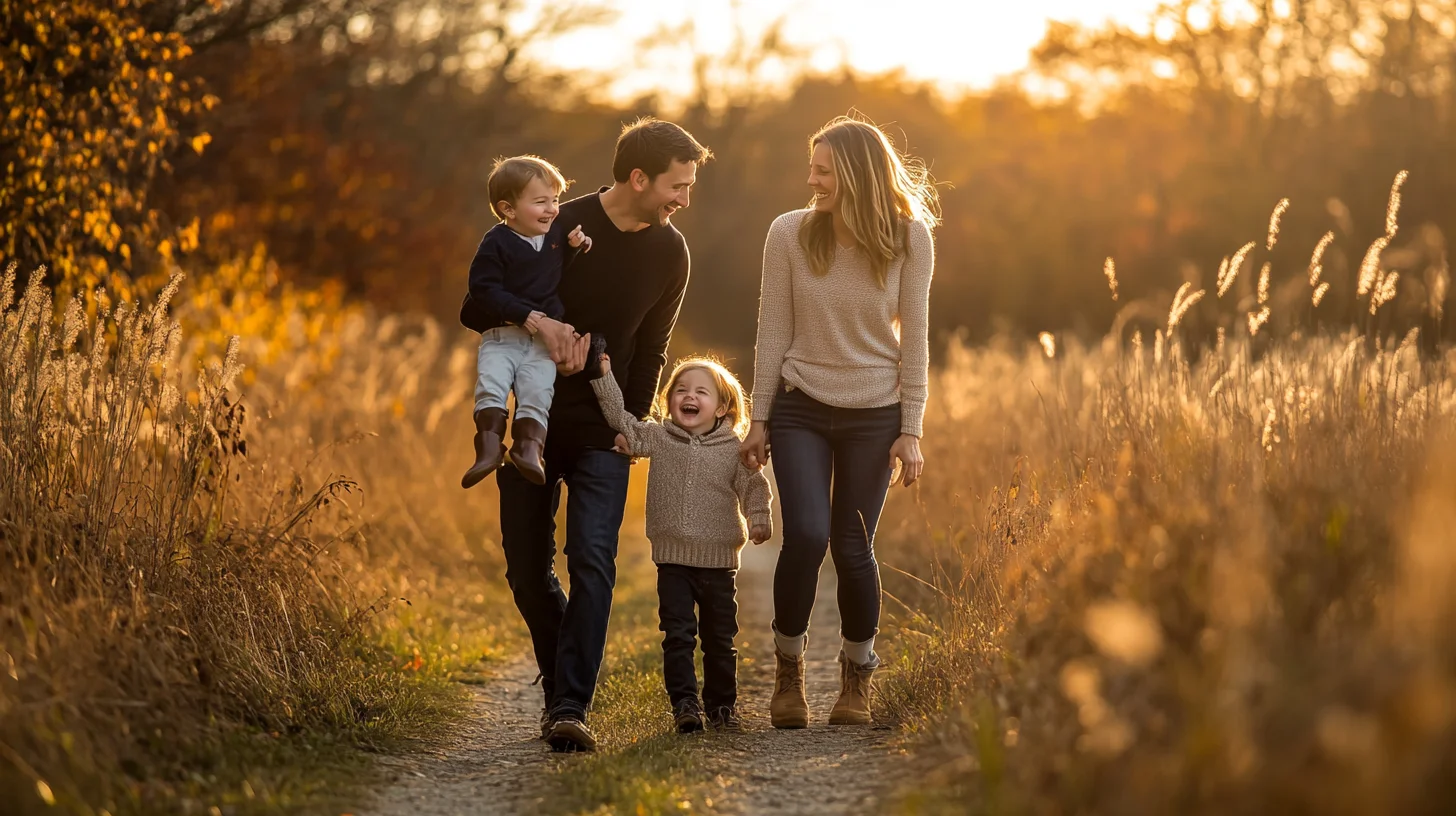
Family portrait posing is less about poses and more about prompts. The single best family portraits don't come from holding a position — they come from giving the family something to do together that gets them connected and natural in front of the camera.
As a South Shore family portrait photographer based in Rockland, I've shot hundreds of family sessions at World's End in Hingham, Duxbury Beach, Wompatuck State Park, Scituate Lighthouse, and dozens of other coastal and conservation locations across the area. The poses below are the ones I rotate through on every family session — from couples with one toddler up through eight-person multigenerational sessions. They're built to work for real families who don't pose for a living, and they survive children who don't want to cooperate. More importantly, they're built around prompts and movements that produce genuine expressions — the images that end up on living room walls and get passed down rather than archived in a hard drive folder.
Why Family Posing Fails — and What to Do Instead
The traditional “everyone smile and look at the camera” approach only produces usable frames in about 20% of the shots in any session. Someone blinks, someone looks away, someone's smile reads forced, the youngest child has turned completely sideways. Holding the frame requires everyone to be performing simultaneously, and that's a coordination problem that compounds with every additional person in the group. A family of four has four independent faces to manage. A family of seven has seven.
The fix is to stop directing and start prompting. When every person in the frame has a job — something physical to do or someone to interact with — their face relaxes because their brain is occupied with the task rather than thinking about being photographed. Three principles underpin everything I do in a family session:
Give every person a job. Standing still with no instruction is the hardest thing I can ask a family member to do. Holding a child's hand, looking at a spouse, chasing a sibling, whispering something — all of these give the body purpose and the face something genuine to express.
Physical contact between people anchors the frame. When family members are touching — hand on shoulder, arm around waist, parent holding child, kids leaning into each other — the group coheres visually and emotionally. Space between people in a family portrait reads as distance; contact reads as connection.
Movement beats stillness for energy. A family in motion produces more natural expressions per minute than a family standing still. Walking toward camera, spinning the youngest between parents, a group hug-and-squeeze — movement breaks the self-consciousness that produces the frozen, performative smiles nobody hangs on the wall. Instead of “everyone look here,” the prompt becomes “Mom, whisper a secret to the youngest. Dad, look at Mom while you do it.” The resulting frame is worth ten posed shots.
The Full-Family Poses That Always Work
Walking toward camera, kids' hands held by each parent. Each parent takes one child's hand, and the family walks directly toward the lens together. Arms swing naturally, hair moves, kids look up at parents or ahead at the camera depending on what's caught their attention in the moment. The result feels completely unconstructed — which is exactly why it works.
Walking away, looking back over the shoulder. The family walks away from camera along a carriage path or beach, then turns back together on cue. This is a reliable end-of-session shot at Duxbury Beach and along the World's End carriage roads — the wide sky or water behind the family becomes the background, and the turning motion creates movement in hair and clothes that static shots can't replicate.
Sit-on-a-blanket triangle. Parents sit on the outside, kids between them in the middle, everyone leaning in casually. The triangle composition keeps the group tight, the blanket becomes a natural prop for kids to fidget with, and the slightly lower camera angle creates an intimate, level-with-the-family perspective that towers over the subjects never achieves.
Standing huddle. The family closes in — parents framing the kids, hands on shoulders or waists, everyone within touching distance of everyone else. This is the “us against the world” frame. It scales from three to eight people, works at virtually any location, and produces strong emotional images because the proximity is real, not simulated.
Looking at each other. Three or more family members exchange glances mid-prompt — I might have just asked Mom to tell everyone her worst joke, or asked the kids to see who can make the silliest face. The camera captures the moment where the family is reacting to each other, not to me. These are often the strongest emotional images in the entire session, and they are impossible to plan — only to cultivate.
Partial Groupings — the Secret to a Varied Gallery
Every family session needs partial groupings, not just full-family shots. Families who skip partial groupings end up with a gallery full of the same configuration repeated across different backgrounds — interesting locations, same group. Partial groupings break the visual monotony and produce the emotionally resonant individual-relationship images that often become the most treasured portraits in the entire collection.
The key combinations I build into every session: Mom with all kids, Dad with all kids, parents alone (the “we still like each other” shot that parents are often surprised to discover they love), each parent with each child individually, and siblings together without parents. That last one — siblings-only — produces some of the most genuine interactions of any session, because the dynamic between siblings is completely different when a parent isn't in the frame.
I typically block ten to fifteen minutes mid-session for partial groupings, after full-family shots are secured and before kids hit their attention-span ceiling. Coordinated outfits help enormously here — when the family has dressed with a consistent palette, partial groupings feel cohesive alongside full-family frames rather than looking like different shoots.
Posing Kids Without Melting Down
Kids under four: never pose, always prompt. Hand them a leaf, a shell, a stick, a piece of driftwood from the beach. Ask them to find something, carry something, show it to Mom. The moment you try to direct their body position, you've lost them. The task-based prompt keeps them engaged without requiring them to understand what a “pose” even is.
Kids four to seven: short windows, fast execution. This age group can follow a simple direction — “stand next to your brother” — but the attention window is roughly sixty seconds before they're off. Get the frame quickly, then move on. Don't hold a setup waiting for perfection. Two or three good frames from a sixty-second window beats zero from a five-minute forced pose.
Kids eight to twelve: specific physical instructions land best. “Put your hands in your front pockets” works dramatically better than “be natural.” This age group is self-conscious enough to overthink vague direction but specific enough to follow concrete body cues. Give them something to do with their hands and their body finds the rest.
Teens: give them autonomy. Ask their preferences, involve them in location choices, photograph them slightly apart from younger siblings for at least part of the session so they aren't permanently framed as “the big kid.” A teen who feels like a participant rather than a prop will give you completely different energy in the images — and often becomes the most compelling subject in the entire session.
The single best universal prompt for kids of any age: tickle the person next to you. Laughter is automatic and immediate, the surrounding family members react genuinely, and the frame you get two seconds in — the open-mouthed laugh, the defensive lean-away, the parent trying to keep everyone upright — is worth more than any held pose I can direct.
South Shore location note: open spaces work better than tight beach spots for sessions with toddlers. The meadows and carriage roads at Wompatuck State Park and World's End give toddlers room to wander while keeping them within frame reach — unlike narrow beach access paths where a running two-year-old vanishes immediately.
Prompt-Based Poses That Get Genuine Reactions
The prompts that produce the most usable frames per minute in a family session are the ones that create interaction between family members rather than between the family and the camera. Here are the specific prompts I reach for most:
Walk and look at each other. The family walks side by side, looking at one another rather than at the lens. The conversation happening in the frame is real — I often prompt it by asking Dad to tell the kids something embarrassing from when he was their age. The resulting laughter doesn't know a camera exists.
Whisper prompts. Parent whispers something to the youngest. Child whispers something to a sibling. The whispering creates lean-in, physical contact, and an anticipation expression on the face of the recipient — three compositional elements you cannot direct. Catch the frame at the moment the secret lands.
Spinning the youngest between parents. Mom and Dad each hold one of the youngest child's hands and swing on a count of three. The child's face is pure joy. The parents' faces watching the child are something harder to name — recognition, tenderness, the specific look of a parent watching their kid be delighted. This is the frame that ends up on the holiday card.
Group hug, count of three, then squeeze. Everyone in, arms around each other, and on three — actual squeeze. The post-squeeze frame, when everyone has slightly collapsed into each other and someone is laughing, is almost always better than the held-hug frame that preceded it.
Look at the youngest. I ask every family member simultaneously to look at the youngest child. On a family of five or more, this produces a composition that reads like the entire family is organized around protecting that one small person — which is often exactly how the family actually feels. This is among the most emotionally resonant frames I capture in any multigenerational session.
Multigenerational and Large-Group Family Poses
Large family groups require compositional structure that smaller groups don't. The key principle is to stagger heights without creating a rigid line. Tallest at back, kids in front — but break the line by having parents kneel beside children, by pulling one grandparent to the side, by placing a toddler on a grandparent's lap. The goal is a cohesive group with visual depth, not a school-photo lineup.
Two-row stack. Grandparents seated on a bench or stone wall, parents standing behind them, grandkids standing in front or seated on knees. This is the classic multigenerational pose for good reason — it layers the family across three generations in a frame that reads immediately as “this is everyone.” The stone walls at Hingham Harbor and the bench row at Plymouth Waterfront are purpose-built for this setup.
Triangle composition. Anchor with the eldest family member — a grandparent seated or standing at center — and frame the rest of the family outward and downward from that anchor point. The triangle creates visual hierarchy that tells the viewer who the group is organized around.
Never line everyone up shoulder-to-shoulder at equal spacing — leave breathing room between subgroups (parents with their kids, grandparents with theirs) so the image reads as a collection of relationships rather than a crowd. For groups of ten or more, I apply the thirty-second rule: get the everyone-look-at-camera frame fast, in the first thirty seconds, before attention spans collapse. Then immediately break into partial groupings for the rest of the session. The full-group frame exists. Now let's make something interesting.
South Shore Locations That Match Each Pose Category
Walking and movement poses belong at Duxbury Beach, Hingham Bathing Beach, and the World's End carriage roads. Wide open foreground gives the walking family room to build momentum before the camera, and the long sightlines let me capture the full family in frame without compressing the depth that makes these images feel expansive.
Seated and blanket poses work best at the stone walls of Hingham Harbor, the granite outcroppings at Cohasset Sandy Beach, and the waterfront benches at Plymouth. The natural texture of stone and granite adds visual interest to seated compositions, and the slightly elevated position of a wall seat allows the photographer to work at eye level with seated adults while keeping children in natural frame.
Tight huddles and partial groupings suit enclosed spaces — the wooded trails at Wompatuck State Park, the tree canopy at Bare Cove Park in Hingham, and the brick walls of downtown Rockland. The enclosed background keeps the eye on the family rather than pulling it across a wide landscape, which is exactly what partial-grouping intimacy requires.
Multigenerational stack poses find their best South Shore homes at the Cohasset Common gazebo, the bench row in Hingham Square, and the wide paths of Norwell Town Forest — locations with built-in seating structures that support two-row configurations without requiring the family to bring anything.
For cold-weather and winter sessions, the Rockland studio at 83 E Water Street provides a clean indoor alternative — a warm, controlled environment that works especially well for partial groupings and close-in poses when the South Shore weather makes outdoor sessions impractical.
FREE GUIDE · PDF
78 poses, one per page
The free Family Session + Posing Guide puts 78 family poses on their own pages, from classic groupings to playful lifts and quiet cuddles, each with tips to make it work.
Download the free 78-pose family posing guide (PDF) →Frequently Asked Questions About Family Portrait Posing
What if my family really won't cooperate for posed shots?
That's actually the goal. The family portraits that age best aren't the ones where everyone behaved perfectly — they're the ones where you see each person being themselves. I rely on prompts (movement, whispers, tickling, walking) more than held poses, so a family that resists “stand here and smile” usually produces the best gallery I deliver all year.
Should we practice poses before our session?
No. I'd rather coach you in real time than have you arrive locked into a stiff plan. Reading this guide is fine — it gives you a vocabulary — but rehearsing in front of a mirror tends to produce the look we're trying to avoid. Show up, trust the prompts, and let me direct.
How do you handle a family with toddlers who won't sit still?
I plan the session around the toddler. Full-family shots happen in the first 20 minutes while attention is still fresh, then we break to partial groupings (Mom + kids, Dad + kids, siblings) which can be shot in shorter bursts as the toddler refocuses. The session pace is built to deliver gorgeous images even on a chaotic day — that's the entire job.
How many distinct poses will we actually do in a session?
A typical 60-minute family session covers about 10-15 distinct setups across full-family, partial groupings, and prompt-based candids. The goal isn't to nail every pose in this guide — it's to find the four or five that look most like your family and lean into those. Variety in the gallery comes from groupings and locations more than from poses.
PRO TIP
“The single best prompt for stiff family portraits: ask the parents to lean in toward each other and whisper something the kids can't hear. Kids immediately get curious, lean in to listen, and the entire group's energy reorganizes around that small intimate moment. Catch the frame two seconds in.”
Booking a South Shore Family Session?
Family session dates across Hingham, Duxbury, Scituate, Rockland, and the surrounding South Shore communities book quickly in spring and fall. Reach out to check what's available for your preferred season and location.

ABOUT THE AUTHOR
Chris McCarthy is a portrait photographer based in Rockland, MA who has been photographing the South Shore full-time since opening his studio in 2014 — more than a decade of outdoor and lifestyle portrait work across the region. He specializes in headshots, senior portraits, branding, family, and maternity photography — shooting at his studio at 83 E Water Street and on-location throughout southeastern Massachusetts at places like World's End, Scituate Harbor, Duxbury Beach, and the North River conservation land in Norwell.
More from the Blog
STYLE GUIDE
What to Wear for Family Portraits
How to coordinate outfits for a South Shore family session — palette building, what to avoid, and season-specific picks for coastal and park locations.
FAMILY PORTRAITS
Why Mom Should Be in Family Photos
The person behind the camera is missing from the record. Here's why that matters — and how to make sure this session changes that.